
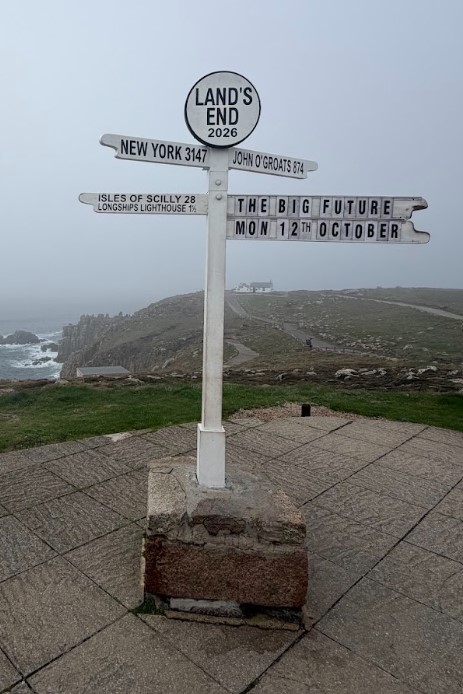
Land’s End is where England, quite literally, runs out. The signpost points one way to John o’ Groats and the other to New York, and behind it the cliffs drop into the Atlantic. Pleasingly, on 12th October, that sign also read ‘The Big Future’.
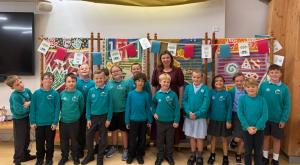
The nearest pub is called ‘The First and Last’ – it is either the first or last pub in England, depending on what direction you’re heading from. We went past it on the way to Land’s End, to speak to children from Sennen Cove, and it felt like an apt reminder of where I and my office were: the last stop of the tour, and the first part of what comes next.
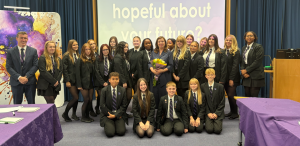
The children of Sennen Cove were kind and articulate – credits to their school, their families, and themselves. For tourists, Land’s End is a stop on a journey. For the children I met here, it is simply home. And as I learned, growing up here brings its own particular joys and its own particular struggles.
They loved ‘beach school’, learning about the local area and activities that included the sea. One child told me why it was good, in an apt metaphor for wider childhood resilience: “I love surf school on the weekend because I can learn how to fall off, check I’m okay, and then get back on.”
They loved living in Cornwall, with the stunning natural beauty and access to the ocean. They all were very proud of their community, and noted that the fact they all knew each other in their village was a protective factor in their lives.
They told me about their concerns. Surfing, they explained, was their favourite way to unwind, and as such they found the presence of pollution in the sea intolerable. One child revealed they had become sick due to ingesting contaminated seawater after a sewage discharge.
They were very worried about the impact of public infrastructure on their ability to choose – a theme I highlighted in my Childhood Lottery launch speech. For Sennen’s children, the lack of buses, both from schools themselves and public transport, meant that for many, there was effectively no choice of secondary school – “I guess I’ll just go to [local school], because it’s closest, it’s the only one I can get to”. That was the case for many – they would attend the one that was easiest to get to, and that would simply have to be that.
When I set out from Carlisle, I wrote about the importance of stories. How no culture lives without myth, and my desire to hear the story that England’s children would tell me.
I did this by thinking about Arthur, subject of our national myth in England. Cumbria claims the castle of his father, Uther Pendragon, and the forest of the Green Knight. It seemed only fair to finish here in Cornwall with the story of Arthur, having listened to children’s stories.
Out beyond Land’s End, legend says, lay Lyonesse: a green and fertile kingdom of towns and churches, the home of Tristan – and Tristan’s father, if you prefer Malory’s version – stretching all the way to the Isles of Scilly.
There are different stories about Lyonesse, which is, as Tennyson puts it: A land of old upheaven from the abyss / By fire, to sink into the abyss again, but in most of them it’s the same ending: Lyonesse sinks beneath the waves.
Like many legends, it is a story about loss: a whole world, taken by the sea. And I will be honest; some of what children told me on this journey has sounded like that. A sense that the future they were promised is slipping away. That the ground is shifting beneath them, and the adults in charge have failed to notice or respond.
I have heard so many worries on this tour.
Children have shown they are deeply concerned with the built environment around them and the public realm. In Cornwall, it was pavements and safer country roads, in Birmingham it was rubbish collection, and in Cumbria and Cornwall alike bus travel was a real concern. I have heard concerns about racism and intolerance, about state failure. I have heard about the deleterious impact of our online culture, and so many thoughts on the social media ban for under 16s, pro and against.
In many locations, I have had a sense of real instability, a sense that I am speaking to a generation wrestling with a fiscal settlement that does not favour them and the death of a meaningful script for their lives. I have heard a recognisable sentiment; that it feels like the generations before got a script – industries and jobs they could generally rely on falling into. That the idea that being wholly responsible for one’s life at 16 works very well for some children, and is making others feel ill with the agony of choice.
There is much happening here; nostalgia, history, economic change, atomisation, and the moving of our lives online are, I think, all contributory factors, and it will take analysis of children’s responses to The Big Future to fully understand children’s sentiments on this issue.
It was all this I reflected on as I headed back up, towards St Austell, and the following day’s meeting with children.
What would that final discussion bring?
The answer is hope.
Perhaps this is my own narrative tendency – after all, Arthur is the once and future king. The belief is that he can come back, the story one of regeneration.
But it is hard to stand in a lush rainforest biome in what used to be an old, spent clay china mine, watching children planting new seeds, and not come away with a sense of hope.
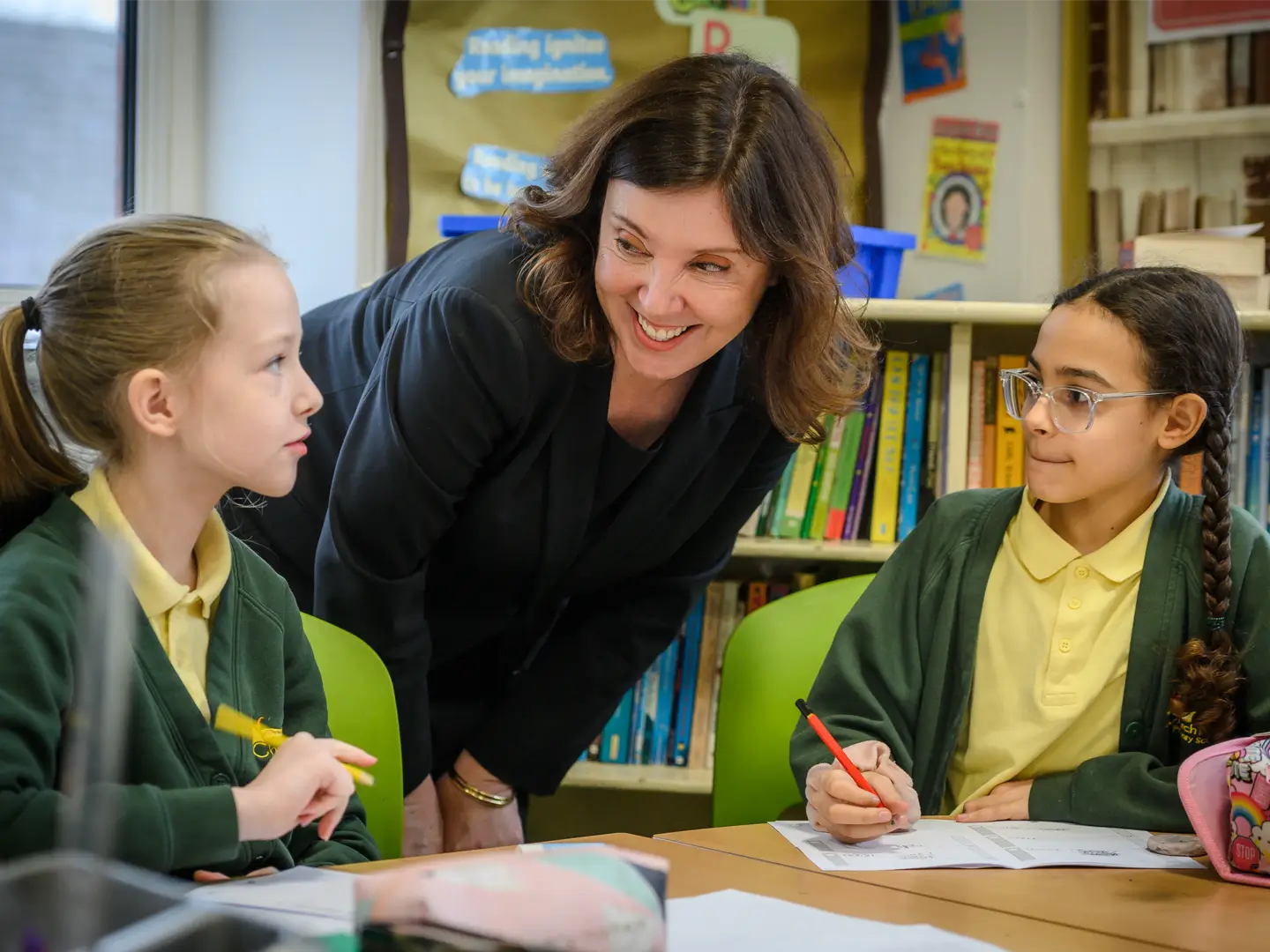
The children there had developed a relationship with the Eden Project over the past few years. They’d never known the clay pits, only the beautiful site that has stood there for the last 25 years. And this rubbed off on them. Their answers were full of concern for the environment but also of profound concern for others, and occasional bafflement at inequity.
It felt like a timely reminder of the power we have to change things. To take a knackered clay pit and build a world-class ecological attraction takes lots of things – resources, effort, time, money, people. But fundamentally, that journey towards change starts with a few people deciding that things can be better, and presenting a vision of what that better world could be like. That is what children have been doing in their responses to The Big Future.
It is my hope, more than anything else for The Big Future, that it forms the basis of a new vision for childhood.
We know that childhood can be better. As my recent report, The Childhood Lottery, demonstrates, almost nowhere in England can sit back and declare that they are truly delivering for children. We need change.
That change must come from England’s children themselves. Over the last few months, I have heard their ideas for change for the country, their hopes, and their worries. It falls to us adults to listen to them.
It is precisely that thought that brought me hope as I boarded the train back to London, and left the place where Lyonesse supposedly once stood.
For the nation’s children, why not aim for a new Eden?