The Office of the Children’s Commissioner for England laid its annual report and accounts for the period April 2024 to March 2025 before Parliament on Tuesday 14th July. Here, the Children’s Commissioner Dame Rachel de Souza introduces these accounts, a summary of project work, impact and financial activity for the financial year.
When I took office as Children’s Commissioner, I did so with a singular ambition: to listen to England’s children, wherever they were. Over the past five years, I have heard their voices and seen them cut through Westminster debates. I have continued this mission through my penultimate year, and I go into my final year as Children’s Commissioner with the same commitment and determination that I started the first. As one young person told me recently, we need to get their voices ‘into the cracks’ of policy making.
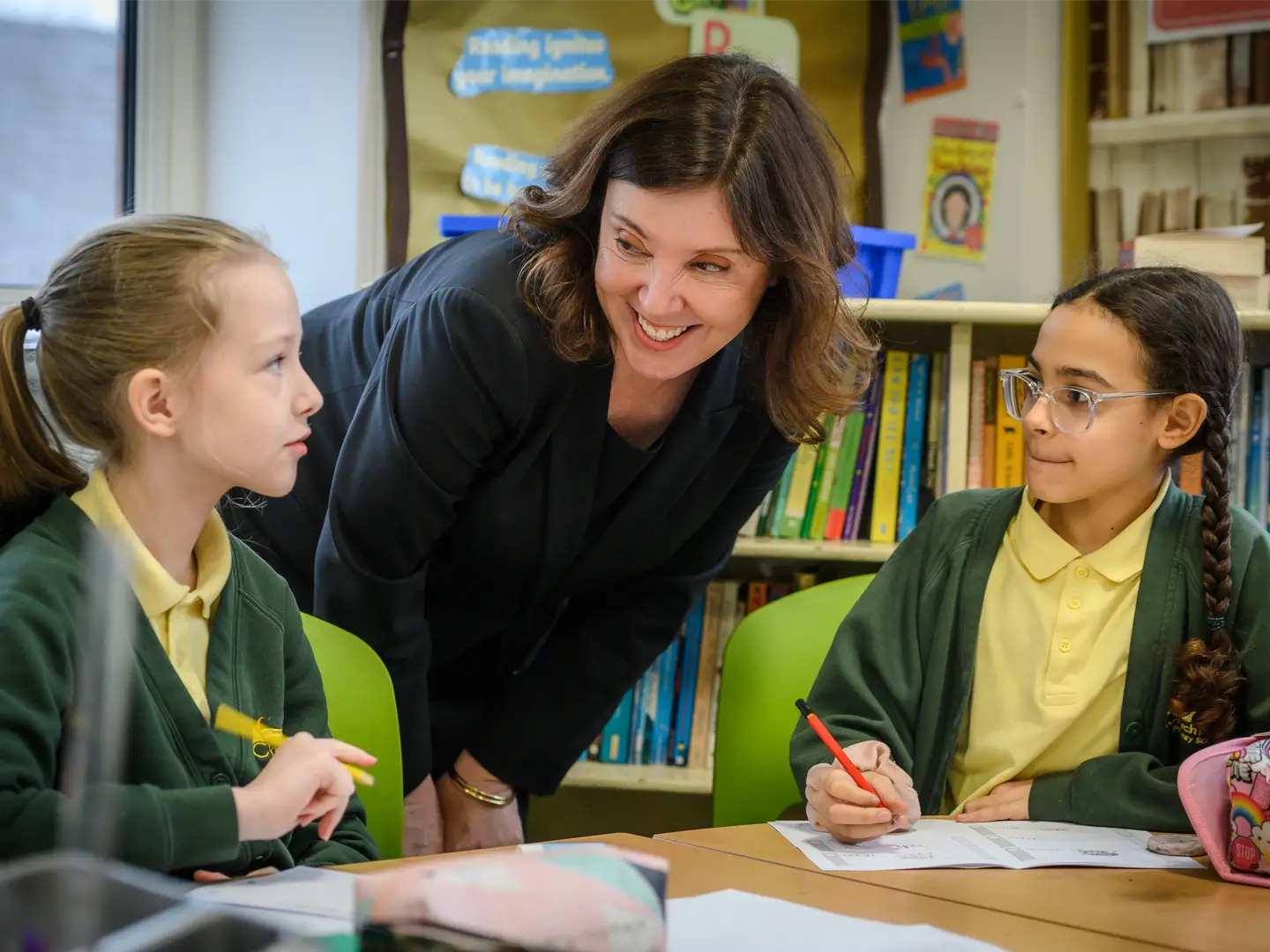
Everything in this year’s work flows from that foundation. To hear the voices my work requires, I travelled the length and breadth of England, conducting more than 100 visits and events, speaking to children in schools, hospitals, care settings, and custody. I spoke to over 100 children growing up in low-income households, visited secure children’s homes, and heard from children remanded into custody, many of whom would never go on to receive a custodial sentence. I want to thank every single child I spoke to this year. Every single one of those conversations changed what I knew, and what I was able to say.
I believe that this ambition found significant expression in my Children’s Plan, a report which defines the work of this last year. The Children’s Plan sought to be a solution to problems years in the making. When this country embarked upon a generational effort to deliver educational reform, we understood that standards would be at the heart of our work. We understand the importance of high standards, high-quality pedagogy, and clear accountability now. What we lacked was an understanding of the wider factors in children’s lives – pastoral care, the professionals working in schools. More than anything, The Children’s Plan is rooted in a conviction that mere parts of the body of the state acting alone will never be enough.
Children’s lives do not divide neatly along Departmental lines, and the most vulnerable children – those in custody, in unsafe placements, stuck in hospital beds, growing up in poverty – have always fallen through the gaps between systems that were never designed with them in mind. What my report demanded, above all else, was a new vision for children: one that begins with the child, not with existing state structures. To build that vision, I had to balance two things that are too rarely held together: the hard architecture of data, and the granular, irreducible reality of individual children’s lives. What that process revealed, again and again, was how much we simply did not know: about what children were experiencing, about what they needed, and about how profoundly policy was failing the most vulnerable among them.
The consequences of our failures are most sharply shown in the work of my Help at Hand team. My incredible team of advocates dealt with more than 1,100 new referrals this year, a rise of over 20%. Each one of those calls is a child caught between systems that would not bend to meet them: unsafe care placements, immigration issues, or homelessness. Help at Hand is where the Children’s Plan’s central argument becomes impossible to ignore. These are children whose rights are not being upheld, not because people are wicked, and not even because no one cares, but because state services have not yet been organised around their needs.
That same lesson runs through my report into children with long-term hospital stays. It began, as my most important work often does, with a single child: a girl who was medically fit to leave hospital but could not, because health services and children’s social care could not agree on what happened next. She was cared for, but without the love that she needed. She was a consequence, in so many ways, of a state that had not asked how many children were in her position. And so, I asked exactly that. When we looked, we found hundreds. This is a key theme across so much of my data collection when I hear that ‘we didn’t know’ – the absence not of knowledge but rather the absence of a system with any reason to look. It is only by looking that we begin to close the distance between what decision-makers assume about children’s lives, and what those lives actually contain.
Nowhere is that distance more troubling than in the experiences of children who are most at risk of being rendered invisible altogether, the children in illegal children’s homes, or the more than 500 children remanded into custody who will not go on to receive a custodial sentence. My Longford Lecture this year focused on exactly this: the criminalisation and adultification of children in care, and the use of custodial remand on children for whom custody is neither just nor necessary. The government’s swift response to my recommendations was welcome, but should never have been needed.
The rights of children must never be an afterthought, attended to only when an advocate forces them into view. I have been asked, this year, to review education in Young Offender Institutions, to co-chair the expert panel on 0-5 screen time guidance, and to monitor the Government’s SEND reforms. I have been delighted to listen to, and represent, England’s children across all of these complex matters. It is, I hope, a growing signal that the new vision The Children’s Plan calls for – a system that listens to children, and puts them at its centre – is beginning, slowly, to take hold.
It is also why my Youth Ambassadors, now in their third cohort, are such a foundational part of my work. They have sat in meetings with ministers, shaped high-level roundtables, and helped build the Youth Voices Hub and Forum. Alongside my youth advisory groups established with Ofcom, the Government Office for Science, and the DfE’s AI team, they represent the clearest answer to what should always be our founding question: not just what do we think that children need, but what do children actually say?
To this end, I have ensured that the work of my office is responsive to individual stories and experiences across the year. Responding to concerns around children’s voices not being included in debates around the Assisted Dying Bill, I acted quickly to speak to children and promote their voice, adding their views to a vitally important national debate.
I have also looked at children’s experiences of’ nudification apps’ – my report based on children’s experiences helped to shape the response to controversy around X’s AI feature Grok later in the year.
Now my attention turns to my final year as Children’s Commissioner. An emerging theme of my work this year has been the intrinsic value of childhood as a state of being, of ensuring that England’s children have the time, space, and resources to simply be children. This will continue. The major focus of my final year will be a final survey for all children in England – the Big Future. At a time where childhood itself is the subject of much concern, and where the Government is considering significant changes to the environment of children’s lives, from social media bans to deep concerns around youth employment, my survey will do what the Children’s Commissioner is charged with doing: ensuring that the experiences and voices of children are front and centre of the national debate, and asking them what kind of world they think children should live in.
As our nation faces changes and challenges, I have no doubt that children will have experiences, perspectives, and beliefs that are vital to how we respond to them. There are few issues that impact children that children themselves have no opinion on. They are already thinking, discussing, and imagining a better world. The job of the Children’s Commissioner, and all of us, is to listen.