The following blog contains reference to self-harm and suicidal thoughts.
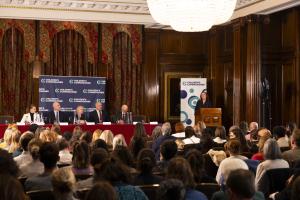
Earlier this week I published The Childhood Lottery outlining children’s different experiences of childhood, depending on where they live. At the launch event, I was joined by several of my former and current Youth Ambassadors who helped put questions to the panellists – including 17-year-old Sebastian who is sharing some of his experiences today.
Today it seems that we cannot have a conversation about what it is like to grow up as a child today without talking about mental health. My journey with my own mental health has been long. When I was seven, I was diagnosed with clinical obsessive compulsive disorder – and it has been a part of my life since.
Then, when I was thirteen and about to start Year 9, I became ill with a virus which evolved into chronic fatigue syndrome, which massively affected my energy levels for over a year. During this time, I missed a lot of school, and I started to feel like I was struggling to keep up in lessons, and this put a strain on my relationships with friends.
Normally, if you have CFS as a child you have a very good chance of recovery, however each experience is unique and no medical professionals could give me any clear sense of recovery timeline or tangible steps to take. So while everyone was expecting me to recover quite quickly, as the months went by the uncertainty and the number of things I was unable to do continued to have a big impact on my mental health. I isolated myself from friends and I hid how much I was struggling from everyone.
The things I was feeling built and built until the point that in the summer of Year 9 I started self-harming.
I hid this as well until the point that I had to seek medical treatment for some of my injuries on two separate occasions. At this point it felt for me like the flood gates had opened. The urge to self-harm was getting stronger and stronger and I was increasingly having suicidal thoughts. I needed help.
Both times that I sought medical help, an emergency referral was made to the Child and Adolescent Mental Health Services (CAMHS). Social services and my school were also both informed by the NHS. However, CAMHS could only offer me an appointment with a counsellor in two months time.
In the meantime, I was given the option to see a school counsellor. The problem for me was that while valuable in many situations, counsellors tend to focus on short term issues, which didn’t offer deep enough support for what I was experiencing. Psychologists focus on longer term issues and at that point this is what I needed.
I felt stuck. My school could not offer me the level of support I needed and CAMHS would not refer me for higher level support until I had met their counsellor, which was not available for two months.
But fortunately, I had an escape. At the point where I most needed help – specialist help – I was able to access the help I needed because I am lucky enough to come from a family that has access to medical insurance.
I started seeing a child psychologist within a few weeks. I kept seeing them every week for the next year, and the year after that I saw them every two weeks. The process of getting better was slow and difficult, but I got better because I had that support.
I was also helped because I was surrounded by people who I could trust and who cared. My mum did not stop until she had found me the support I needed. There were also several teachers at my school who were incredibly kind and made time to talk to me and check-up on how I was doing. One of the teachers even took me to a doctor when I had needed help whilst on a school trip.
But I know that not every child will be able to access help in this way. Several of my friends have also had huge struggles with their mental health. They have self-harmed and had suicidal thoughts, but they have not received the help that I did.
Getting the right support at the right time makes a world of difference. I no longer self-harm or have suicidal thoughts – but I know that children who cannot access the support I did will likely continue to struggle. Getting support should never be determined by where someone lives, how their family can support them, the type of school they go to. It’s not right that children are having different experiences of childhood. Every child should have the same opportunity to thrive and reach their potential. And we have to make sure that every child who needs help, gets the support they need.