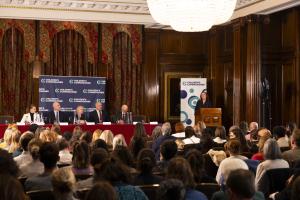
On Monday the Children’s Commissioner Dame Rachel de Souza published The Childhood Lottery, at the launch event in Westminster she delivered the following speech:
Every day in England, on average, about 1,600 children are born.
Today, I want to tell you about two of them.
They could be any two children, in any two hospitals.
But for today, let’s call them Daniel and Lyla.
Daniel and Lyla will both be born at 4am tomorrow.
They will stay with their mums on a postnatal ward while everyone gets them ready to be discharged.
And then they will leave hospital, and start to head home.
That will be the most important journey of their lives.
Where that journey ends, in what postcode, might just define who they will become, because of the variation in the services that will be available to them and the world they grow up in.
Daniel and Lyla have left hospital.
If Lyla arrives in Richmond upon Thames, she will grow up in an area where 11% of children are in poverty.
And if Daniel’s family car is headed to Tower Hamlets, then he will grow up in an area where half of children are in poverty.
We’ll come back to Daniel and Lyla a few times.
But for now, let me tell you about the research I have published today: The Childhood Lottery.
I have travelled across the country, speaking to tens of thousands of children.
Let me tell you.
They are ambitious, they love where they live, and no matter what they are always hopeful.
But that hope is not rose-tinted.
They are aware of the challenges in their area.
What they want to see is those challenges addressed.
I wanted to discover not whether there is a postcode lottery. But the extent of it.
I have seen, more than most, and like many in this room, the challenges that children face.
I dedicated my career to making sure every child, wherever they are born has access to a brilliant education because so often that isn’t the case.
What I have found here though, has shocked me.
I’ve looked across more than 160 metrics – covering education, health, crime and community – there are simply too many alarm bells ringing.
Not just because it is so bad, but because we have normalised the failure.
And because of this, I have made the difficult decision to highlight the 20 places where it is hardest to grow up.
I want to be clear that this is not a review of the local authority, this is an assessment based on a wide range of measures looking at the challenges faced, the full range of services available and the outcomes we see.
I want this to be an aid to those areas where childhood is hardest.
To shine a light on where children need the most rigorous attention.
Because we cannot shy away from the fact that indicators such as poor education outcomes, long health waiting lists, or simply feeling unsafe converge in particular places.
It is also no coincidence that as Children’s Commissioner I have already visited many of these places to hear directly from children.
And I am pleased to have my youth ambassadors here today to speak directly to the audience and panel.
And let me be clear, every single local area in England has work to do to make lives better for their children.
All of England’s regions are represented in the 25 places where my data shows childhood is hardest, including…
…Middlesbrough in the north east, Bradford in Yorkshire and the Humber, …
…Hounslow in London, Peterborough in the east of England, Liverpool in the north west, …
…Somerset in the south west, Nottingham in the east Midlands, and Birmingham in the west Midlands.
It’s time for Daniel and Lyla to get their childhood vaccines. These are essential to protect them from illnesses that could meaningfully change the course of their lives.
If Daniel lives in London, he is far more likely to not receive the hugely important MMRV vaccine.
London LAs make up all ten of the places with the lowest vaccination coverage.
Whereas if Lyla lives in Cumberland, then she’ll be in the 94% of children who do receive their vaccinations.
We speak about this like it’s normal.
As if that data isn’t absolutely baffling.
44% of kids in Kensington and Chelsea aren’t getting vaccines for illness that can and do harm children all over the world, every day, and we treat it like that isn’t a crisis.
In some communities, these challenges amount to nothing less than a state of emergency.
Not for every child.
Not everywhere.
But what we see here is a litany of failure.
In so many local authorities, on individual areas or multiple, children are being radically failed.
If you send 90% of your kids in care out of area, away from their friends, their family, their school, what is that?
Is that normal?
Do we accept it?
Or is that an emergency for children in care?
My contention is simple – we wouldn’t accept the standard of state services that we give children anywhere else.
And all of this is particularly vital in today’s debate, which is focused on devolution.
Devolution represents an opportunity.
It offers a clean break.
The chance for a line in the sand moment.
The problems I have identified are not just at a service level – though sometimes they are – they are utterly systemic.
The system change that devolution represents is a unique chance to remove the extreme inequality and unfairness I have found.
New powers will mean new structures, and therefore new opportunities to think about, listen to, and deliver for children.
Local areas must be provided with support from central government to raise standards for children across health, social care, housing and communities, with urgent action where it falls beyond a set level.
This needs to be our response to the emergency.
But more money needs more accountability, and so I have recommended that areas should have Deputy Mayors for Children to ensure there is a named person, accountable for outcomes, and service delivery.
Think about service delivery for a moment.
Daniel and Lyla are 14 now.
As is becoming increasingly common, Daniel and Lyla are starting to experience mental ill-health.
It began sub-clinically – slightly low mood, some social withdrawal – but it looks like it might worsen.
Early support services can make all the difference here, as Peter has pointed out recently, and I thank him for that work.
If Daniel lives in Leicestershire he might be one of the roughly three quarters of children who aren’t covered by school Mental Health Support Teams.
He will not get that early support as a result, forcing his family to try and grind through a CAMHS waiting list.
However, if Lyla lives in South Tyneside she is likely to be one of the 99% of children who do have access.
Some services should be universally available.
Given national concern around child and adolescent mental health, mental health support in schools is one of these services.
We will also need to understand children.
My 2025 research report The Children’s Plan illustrated how little we sometimes know about children’s lives.
This was the case here, too.
Piecing together data about children’s lives to obtain a well-rounded picture was made more challenging by discrepancies in how local services are delivered across geographies.
Local governments must understand their own cohorts of children, and what life looks like for children in their areas, in order to empower them to make decisions which truly improve children’s lives across the board.
And that leads me to turn now to the other, rather more insidious side of these differences.
How they rob children not only of state services but of choice.
Daniel and Lyla have just finished their GCSEs.
Gone in on results day.
Cried with joy, though Daniel will spend the next ten years not admitting that.
And let’s say that Daniel and Lyla have both tried hard on some things – maybe less on others, they’d admit it themselves – and both scored above average GCSE results.
This should matter, surely?
No.
What if Daniel lives in Knowsley and Lyla lives in Rutland?
Well, then Daniel might outperform his classmates in Knowsley, and maybe Lyla is a bit more average for Rutland.
But it’ll matter a lot less.
Because Lyla will almost certainly be amongst the 96% of children in Rutland who do A-Levels.
Daniel will almost certainly be amongst the 96% of children in Knowsley who do not.
Daniel won’t even have the choice.
There is currently nowhere in Knowsley that even offers A Level provision.
Even where children do the right thing, study, apply themselves – differences in provision serve to exacerbate inequality, and rob children of the chance to choose their futures.
I have conducted this work at the same time as touring the country to promote my survey, The Big Future.
And as part of this work, I went recently to Middlesborough.
I spoke to the hardworking, caring public servants and frontline staff who are dedicated to Middlesborough’s children.
The children I met were ambitious, brilliant and wanted to be proud of their local area. Let me tell you what one of them has said.
‘The community should work together to make Middlesborough a better place.’
At the moment, in too many places, that isn’t happening.
I have seen what it looks like for children to grow up in a difficult place.
I have listened to a 14 year old girl tell me about the crime statistics in her local area.
Children should not have to know those statistics.
Their parents should not have to talk about them over dinner to explain why they can’t play outside.
The sadness of children who can’t play outside is tangible.
Schools should not have administrative staff dealing with drug overdoses and racist thugs.
I defy anyone to listen to children tell me what they have told me, to live in the conditions I’ve seen children live in, and defend the status quo.
And I’m telling you we would not accept this for anyone else.
I do not accept this for the children of Middlesbrough. We must match their ambition with far greater ambition of our own. Let’s make Middlesbrough the best place to grow up in England.
Because yes, the examples I’ve used are just that. Examples.
Stories to illustrate this data.
But please remember each and every point I told you about the differences in children’s lives.
Because I began this speech about 10 minutes ago – give or take.
And so, about 10 children have been born as I have spoken to you today.
10 new lives.
And they are real.
Where will their journeys take them?
Well, in many ways that is up to them.
But it is also up to us.
To the people in the room: this data represents things as they are, not how they must be.
It is not written in stone.
It can be better.
It must be better.
We can provide the services, set the baselines, expect the excellence.
Because right now, the stories of those ten children are unwritten.
It is up to us to make sure they have the tools they need to go out and write them.