
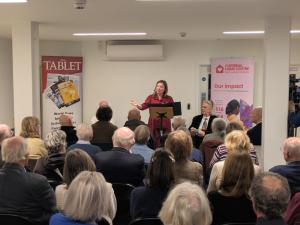
Last night the Children’s Commissioner Dame Rachel de Souza delivered the following speech for the Cardinal Hume Lecture:
Good evening, everybody.
It is such an honour to be with you all today.
Thank you to the Tablet and The Cardinal Hume Centre for having me.
I am the Children’s Commissioner for England.
The role has existed for 20 years – following the brutal and preventable murder of a little girl called Victoria Climbié at the hands of those who should have loved her most.
Many people in this country will remember that name.
I do, every day, in everything I do.
And so, my role was created, to make sure that children were listened to. Their voices and views reflected in the public debate, in policy, and in promises made.
I speak to children arriving here, cold, exploited and lonely, on small boats. I speak to children in mental health wards who are looked after by people who feel more like guards, not nurses.
In children’s “homes” that are actually tents, caravans.
Children who find it hard to communicate, and children who desperately want to be heard.
And I speak to children in schools, at youth clubs. In libraries, at sports clubs. Children whose lives might be considered more ‘ordinary’.
I tend not to think of them in that way, though.
I’ve heard from over a million children since taking office, and I’m yet to meet an ‘ordinary’ child.
Because if there is one thing that animates the work I do, and have done, it is this: there is nothing ‘ordinary’ about childhood.
There are so many things that England’s children care about, but given where we are, and who we are with, and the incredible work that the Cardinal Hume Centre does…
Today I want to speak to you about home.
Children think about home in all sorts of ways.
It is something that they care deeply about.
It looms large in the thoughts of children and young people.
They worry about their home now.
What their home looks like, the faults in it, where it is, how long they can stay there.
They worry about the future.
Our national failing to build enough housing so that they might one day be able to buy one.
Children who grow up in social care tell me their 18th birthday isn’t something they look forward to with excitement, but with fear.
Fear that they will be plunged from a cliff edge, lose access to their support network and be left with no place to call home
These are things children tell me about all the time.
My statutory duty is, amongst other things, focused on children living away from home.
I look at what happens to children who move, who live in homes that are not fit for purpose, or those in the care system where home can mean something a little different.
I see so often all the forms that ‘home’ can take.
And so I have found myself asking how I should approach this.
In doing so, I have been reflecting on children’s literature.
Books exist, it has been argued, to stop you feeling lonely.
But the very best ones remind you what life is like, rather than being a relief from it.
I have been working on prison education, and found myself turning to Solzhenitsyn.
It tells you something about what a type of life was like.
Great children’s literature, like all great literature, allow readers the space and time to reflect on some of the biggest questions about what it means to be human.
Some of them introduce children to huge ideas – power, love, and sacrifice in The Lion, the Witch, and the Wardrobe.
Some of them introduce children to incredibly difficult and distressing emotions.
Show them that other people have felt this way too.
That grown-ups feel this way, and – crucially, in our age – that feeling this way will pass.
Consider grief.
We experience it.
So too do children.
And the way that adults and children think about it is not too dissimilar.
The way that we speak about it, in our essays for adults or our books for children are not too dissimilar.
Joan Didion wrote that “Grief, when it comes, is nothing like we expect it to be. … Grief has no distance. Grief comes in waves, paroxysms, sudden apprehensions that weaken the knees and blind the eyes and obliterate the daily-ness of life.”
Michael Rosen’s Sad Book tells children that:
“Sometimes I’m sad and I don’t know why.
It’s just a cloud that comes along and covers me up.
It’s not because Eddie’s gone.
t’s not because my mum’s gone.
It’s just because.”
Even for the youngest children, some of the great books – like Where the Wild Things Are – deal with some truly essential themes.
It deals with how children master various feelings: danger, boredom, fear, frustration, jealousy, and manage to come to grips with the realities of their lives.
Think about what Max does.
He goes to the Land Where the Wild Things Are, and he romps around with them.
And eventually, he declares the Wild Rumpus, and becomes King of all Wild Things, and then he stops.
He stops because he is “lonely, and wanted to be where someone loved him best of all.”
And that, my friends, is home.
Consider those great Finnish philosophers of children’s literature, the Moomins.
In Moominpappa at Sea, we are cast into a scene where Moominpappa has had what is effectively a midlife depressive episode.
A midlife crisis of sorts.
He has tired of Moominvalley, and moved the whole family into his boat, in search of a lighthouse.
They arrive at an island, and their shelter is dark and damp and horrible.
But then they light a lamp.
“The lamp sizzled as it burned.
It made everything seem close and safe, a little family circle they all knew and trusted.
Outside this circle lay everything that was strange and frightening, and the darkness seemed to reach higher and higher and further and further away, right to the end of the world.”
Outside of home are the things that are strange and frightening.
Home is the safe place.
It is where the light gets in.
It is where someone loves us best of all.
Every child deserves a safe and loving home – either with their own family or, where that isn’t possible, in a stable and caring alternative.
That principle should be beyond argument.
And yet I found thousands of 16- and 17-year-olds arriving at their local authority’s door as homeless children in need of care.
I want to be clear about something from the outset: youth homelessness is, fundamentally, a children’s social care issue.
These are children.
And when a child tells us they have nowhere safe to sleep, the response should be the same as for any other child at risk – care, protection, and a proper plan for their future.
I spoke earlier this year at the Jesuit Refugee Service inaugural lecture.
I want to just repeat something I said there, so forgive me if there is any crossover in attendance.
This is a binary issue.
Either childhood means something or it does not.
Either we owe special consideration to children or we do not.
Either we should protect children, or we should not.
I am of the view that it does mean something.
That we do owe special care to children.
That we must protect them.
Failure isn’t okay because they are older children.
I do not believe there is such a thing as ‘basically an adult’, or ‘nearly an adult’ or ‘old enough where it’s less of an issue’ – a child is a child.
This – this fundamental reality of childhood – is the thing we must protect.
Every time we allow a 17 year old to be classified as an adult, we cheapen the category of ‘child’.
This is one of the foundational fights I find myself having of late.
Children are children.
And what we do, because we do not want to give them the due consideration that we owe children, is shift a chunk of them out of that category every year.
My two senior staff who run Help at Hand tell me about this from their teams all the time.
Children being encouraged to seek adult services at some point later.
It is disgusting.
The solution, so often, to problems has not been ‘how can we deliver for children’ but rather ‘how can we redefine ‘child’.
I can’t stress to you how abominable it gets.
Children have told me about being passed a piece of paper explaining what care was, as if that was enough.
They’ve told me about feeling ‘tricked’ into refusing care.
I have heard from them about people taking ages to make the decision – they suspect to try and time them out of being eligible.
Running down the clock, as if a child’s life was some game of football.
We define these children out of childhood.
There is far too much of this.
Too many cases of putting a responsibility on a child saying ‘do you want us to look after you’, when the message they should get from the state, loud and clear and simple, is that ‘we’re going to look after you’.
You know, I want to pause there.
Think about how insidious that part is.
Children aren’t stupid.
They’re just young.
They know the state struggles to house them.
If there was any good to come out of our national debate on assisted dying, I had rather hoped it would be a rethink of how we ensure people do not feel like burdens.
That didn’t happen, of course.
But stop now, and think about the context that these conversations happen in.
Think about how many ways there are to ask if a child ‘really wants’ care.
And where you could put the stresses in the sentence.
How you’d manage your tone.
What words you might use.
And if, say, placements were very expensive, and you thought the 17 year old in front of you was probably going to be fine, and you knew how hard housing would be, and you’d heard about the 12 year old who’s just been subject to a Deprivation of Liberty order you’ll have to house later today…
Well, what words then?
What way do you think you’d nudge them?
I don’t even blame councils for this, by the way.
They’re given terrible budgets and set about triaging horrendous cases of need, left, right and centre.
But as with so many of our national failings, it’s children left at the sharp end.
In 2023, I looked at exactly what happens when a local authority becomes aware that a child is homeless or at risk of becoming so.
What I found was deeply troubling.
In 2022–23, around 6,500 children aged 16 and 17 came forward.
Forty-one per cent of them were not accommodated at all.
And of those who were, only 39 per cent were taken into care under section 20 of the Children Act and given looked-after status – which is what the law intends, and what those children were entitled to.
How a child came to the local authority’s attention made a real difference.
Children who had an advocate supporting them, or who were referred through social services or by their school or college, were the most likely to receive the care they were owed.
In other words, the children with someone in their corner fared best – which tells us what every child in this situation needs.
The most common reason children gave for being homeless was family breakdown.
Around 18 per cent were unaccompanied asylum-seeking children – young people who have often already travelled alone through extraordinary hardship.
Taken together, the findings point to one pressing need: children and families must get timely, appropriate support at the earliest possible point, before problems escalate into crisis.
My Help at Hand team sees the human side of this every week.
They regularly take calls about children caught between systems, including children navigating homelessness.
In November 2024, a charity worker supporting an unaccompanied child seeking asylum, who was facing homelessness, wrote to us after we intervened.
Since our email, she said, the local authority had taken the case very seriously – the young man had already been visited by his personal assistant, and they had promised that accommodation would be found for him by Monday.
That is what can happen when someone insists that a child’s needs are met.
I am proud of this, of course.
But I find it so troubling.
It shouldn’t take a call to the Children’s Commissioner to make it happen.
Housing sits at the very centre of children’s lives, and it is one of the biggest factors shaping their wellbeing.
It comes up again and again across my work; in research on poverty, on children with neurodevelopmental conditions, and on some of the most vulnerable looked-after children, those deprived of their liberty.
When children told me what it was like growing up in a low-income family, many of them talked about their homes: the struggle to afford them, the lack of space for their families, repairs that never came, and living in housing that simply wasn’t good enough.
Children notice.
They feel it.
And they deserve better.
I also think most people’s picture of homelessness is, bluntly, wrong.
We imagine tents and begging – people who are visibly homeless.
But in our towns and cities, homelessness is just as often the family on their tenth sofa that quarter, moving from one temporary arrangement to the next, out of sight.
Housing insecurity is the issue.
I was reflecting on something during a visit the other day.
You see, I go to all the places you don’t want to go.
I am allowed to walk in to anywhere a child is. It’s one of the powers I have as Children’s Commissioner under the law.
Well, there is one exception, and one that has just struck me as worth making here.
I can go anywhere, to speak to children, and listen to their experiences, and learn if they are safe – except a private domicile.
Except, in other words, a family home.
There is something to that, isn’t there?
But yes, I can – broadly speaking – go anywhere.
And so I have seen everything.
Schools, nurseries, youth clubs, sports clubs.
Oh yes, all of those.
But also the other parts.
The containers we place migrant children into.
I have seen the inside of every single children’s prison.
I have seen the cells in police stations where children are taken.
I have seen mental health wards, hospitals, hospices.
The happiest children and those who will not see Christmas.
And so the other week I was in Feltham Young Offenders Institution.
And a really basic thing about children that occurred to me as I was there.
And I found myself about to enter a cell, and a child said to me:
‘Of course you can go in. Would you mind just making sure you don’t step on my shoes though?’
He’d arranged them neatly by his door.
They had been scrubbed clean.
Pristine trainers.
And his cell was filled with things.
A great confusion of stuff.
Books, prayer cards, snacks from the prison shop.
Truly bizarre amounts of tinned fish – I discovered it’s a cheap protein source, and he liked lifting weights.
Now this is a boy who has done something very bad.
And we have placed him in a cell.
Well, fair enough, you might say.
We have put this boy in Feltham, which for those of you not familiar with the justice system is the most violent prison in England, including the adult estate as well.
Not much to work with in those rooms.
Mirror in the corner in case guards need to come crashing in.
No real privacy.
But he had made it his own, as best he could.
A little place that he could call his own.
That is his home.
Joan Didion, that great chronicler of 20th century life, said in The White Album that:
“A place belongs forever to whoever claims it hardest, remembers it most obsessively, wrenches it from itself, shapes it, renders it, loves it so radically that he remakes it in his image…”
For most children, that is band posters, football memorabilia, stuffed animals, books.
Trinkets.
For this boy in Feltham, one of the worst places to be a child, it was whatever he could call his own.
Whatever he could say ‘that is mine, and no one elses’, in a life that was so deeply circumscribed by others.
Like many employers, I have young people who work for me.
When they talk about their first flat in London or their first student digs, most of them had a ‘thing’.
It differs.
It’s their records, their books, their favourite pan.
Once that was unpacked, that space was home.
And the truly wicked thing about insecurity is that it robs children of that.
It robs children of the place where memory settles.
Where a child learns that the world can be relied upon, that tomorrow will look recognisably like today.
It robs them of a chance to claim a space hardest.
To, as Didion puts it, love it so radically that they remakes it in their image.
Material security is the ground on which everything else is built: friendships, learning, rest, a sense of who we are.
When we take that away, we do not simply inconvenience a child. We unsettle the very conditions in which childhood is meant to unfold.
And, my friends, we now have evidence of what that unsettling does.
A few years ago, I looked into what moving does to children’s schooling.
The more times a child moves home between Reception and Year 11, the worse their GCSE results.
It’s that simple.
You know, when children move, we focus on what is new.
A new address.
A new route to school.
Maybe a new school altogether.
But the way that we think about ‘new’ there implies something that has been added to a child’s life.
Like it is synonymous with ‘extra’.
It is not.
Each of those ‘new’ things represents a loss, sometimes a grievous loss, to a child
A new school is a lost friend.
It is a teacher who no longer knows your name.
The loss of adults in your life, your chaotic young life, who already knew you.
Learning depends on continuity, on the slow accumulation of trust and attention.
A child who is forever starting again is a child who is forever being asked to begin from nothing.
We should not be surprised that the cost shows up in their grades.
We should be ashamed that we have allowed it.
For many families facing homelessness, the story does not end with moving.
It ends, too often, in temporary accommodation, and for some children, in bed and breakfasts and other shared accommodation.
Our data shows the full picture, and it is not one any of us should be comfortable with.
Tens of thousands of children are spending long stretches of their childhood in these places: sharing bathrooms with strangers, living in unpleasant conditions, crammed together with their families into a single small room with no privacy at all.
I always get frustrated when I say large numbers.
Yes, it shows the scale of the problem, and we must always care about that.
I do.
But I want to pause for a minute and reflect on something that I think a Christian approach is a useful reminder of.
We are called to the particular.
In terms of how we think theologically, I think this was best set out by Walter Brueggemann.
Brueggemann said the entire biblical revelation is built on the scandal of the particular.
It’s a scandal because it’s so ordinary.
The scandal of this particular person getting this particular revelation.
This carpenter, this shepherd, this stutterer, this fisherman, this virgin.
Who the hell do they think they are?
Why them?
Why does the eternal appear in a time and a place and manifest to individual people?
It’s incomprehensible.
At first.
But then I thought about a sermon preached by the Dominican Herbert McCabe on Good Friday decades ago, that rings true as ever.
He makes a point that solves this, for me.
He says that in all of the Gospels bar John, Christ in Gethsemane is tangibly panicking.
He does not want what He knows is coming.
But He accepts it, because He accepts His mission.
He knows what kind of world we have built, one where to be human and to love wholly means you will be crucified.
Where perfect love will be met with all our flaws.
McCabe says that: ‘Not Adam, but Jesus was the first human being, the first member of the human race in whom humanity came to fulfilment, the first human being for whom to live was simply to love – for this is what human beings are for.’
And that, my friends, explains the scandal of the particular.
It is how love manifests.
Love is particular.
We don’t love humanity.
We love people.
It would be easier if it was abstract, I think.
Humanity does not ask a lot of you.
It’s rare that humanity is particularly demanding of your time or your effort.
People do, though.
Your spouse gets the flu at the most inopportune time.
Your mother says just the wrong thing on a bad day.
Your friend asks to see you on a week when you’re exhausted.
It’s the same for those of you in this room who work on the front lines of this issue.
When was the last time that humanity as a collective made your life difficult?
And when was the last time that an individual service user did?
Humanity rarely needs things from you personally.
The individual person in front of you does.
And so in each of those, let us think of the particular.
That each of those numbers is a child.
A child with nowhere to do their homework but the edge of a bed.
A teenager with no space of their own, no space to fume or grumble, no place to be themselves, no corner that is theirs.
A young child who must queue behind adults they do not know simply to wash.
We speak of temporary accommodation as though the word “temporary” softens it.
But time moves differently for children. A few months in the life of an adult is a season; in the life of a child, it can be a whole chapter, one they will carry with them long after it has closed.
Childhood is not a waiting room.
It cannot be paused while we find a better solution.
It is happening now, and it does not come again.
That is why I am pleased to see the government’s commitment, in its homelessness strategy, to ending the illegal use of B&Bs for families. This matters, and I welcome it. But I want us to be ambitious about what we are trying to achieve.
The problem is not only the privately owned B&B; it is shared accommodation in all its forms.
That is why I have called for an end to all forms of shared accommodation for families with children for longer than six weeks.
A child’s dignity should not depend on the technicalities of who owns the building they are housed in.
When I listened to children through The Big Ambition, they did not speak in the language of policy. They spoke with a clarity that adults often lose.
An eleven-year-old girl told us that we must “make sure all children have a roof over their head and a loving, supportive family around them.”
An eight-year-old girl put it more simply still: “Find homes for homeless children.”
There is a kind of moral wisdom in that simplicity.
Children understand instinctively what our systems sometimes forget: that a home is not a luxury to be earned, but a foundation every child is owed.
It is the issue where I think children’s thoughts slam hardest into reality.
On most things, children are pretty sophisticated when I speak to them.
They don’t like this thing, or that, but they understand that there are grown ups who have thought about it or some kind of trade off happening.
But they just don’t understand why people are homeless.
They simply think people deserve homes.
They’re not wrong, are they?
They are not asking for something extraordinary.
They are asking for the ordinary thing, the thing most of us just had.
So let us take them at their word.
Let us build a country in which the question “where do you live?” is one every child can answer without hesitation, without shame, and without fear that the answer will change again next month.
No child should be homeless.
It really is that simple, and it is time we acted as though we believed it.
At the start of my speech, I told you that home was where the light gets into our lives.
I want to close by reflecting on that light, and on the nature of hope.
The work that this centre does is borne of love, because it work that is grounded in hope.
Archbishop Desmond Tutu put it rather more prosaically:
“Hope is being able to see that there is light despite all of the darkness.”
Light against the darkness.
This is the vision of hope that I want to end on today.
It’s one that I think children in particular understand instinctively.
Children feel deeply.
They like what is known to them.
It’s one of the reasons so many children are scared of the dark.
The dark is the great unknown.
We fear what we do not know.
It is only the light – our hope – that banishes darkness.
And so let me return to the Moomins, one final time.
Little My says:
“Stars are my favourite things.
I always lie and look at them before I go to sleep and wonder who is on them and how one could get there.
The sky looks so friendly with all those little eyes twinkling in it.”
And so when times are hard – and for those of you who will work with children, who work to keep them housed – I am telling you now, things will be hard…
When times are hard, I urge you to look up at night.
Because it doesn’t have to be that way, you know.
The night sky could simply be darkness, endless and unbreakable.
And yet there are stars.
Light will always cut through the darkness, as long as there is someone willing to kindle and protect the flame.