Over the last five years, I have heard from thousands of children, parents and professionals about the impact of the online world – and while many agree it offers the chance to learn, play and connect, it is hard to ignore children’s negative experiences.
As Children’s Commissioner, my first priority will always be the safety of children, who tell me about seeing inappropriate, harmful, extreme content on social media sites – often stumbling on it accidentally, without looking for it.
The widespread debate about the role of mobile phones and social media in children’s lives ramped up last week, as the government announced a consultation that will look at ways to improve children’s online safety – including considering measures like the Australian decision to ban under 16s from social media platforms, which came into force just before Christmas. In the same week, an amendment to the Children’s Wellbeing and Schools Bill put forward by former Schools Minister Lord Nash proposing a ban of all social media for under 16s passed in the Lords.
The events of the past week prove there is a growing awareness in society of the dangers posed to children my research has demonstrated, even if there is not yet an agreed solution. I have been clear that if Ministers were to put forward a clear plan to properly enforce a ban, that is based on how children tell us they access these sites and designed in consultation with them, I would support it.
Without consultation with children, without listening to their experiences of being online and their insights into how the online world is presented to them, a ban will not work. By itself, it is not a guarantee that children will be kept safe online. Without designing it with children’s views, there is a risk they might be driven to different sites and new risks will emerge on sites not covered by a ban.
That’s why I invited Lord Nash to join my Youth Ambassadors for an episode of The Big Conversation podcast. I wanted them to exchange ideas and debate the good and bad of the online world – could they do better than others in coming up with solutions?
As always, the Ambassadors’ reflections and insights were well-considered, practical and showed just how much we have to lose by not listening to their voices. Ministers grappling with these issues would do well to sit up and listen!
Six Ambassadors – Annabel, Anthony, Ariana, Valerie, Violet and Yusuf, all 17 – spoke frankly with Lord Nash about the online world, the challenges they face and their views on imposing a ban across social media and how this would impact the way they interact with each other.
In the conversation they were joined by Fabio D’Andrea, who created ‘Another Way’ – a film about the dangers of smartphones and social media for young people, which was launched in parliament last year.
Fabio shared his concerns about the impact of social media on young people’s lives. He said “Social media is really decreasing our levels of education. The algorithms are specifically designed to keep you addicted to using those platforms. Our concentration levels have decreased, and that’s not just for younger generations. It’s for every generation. And I think that’s one of the most important things we need to address.
“This technology is amazing, and like every technological change, there’s good things that, that can be harnessed for society. However, we have a lack of control over how these apps keep us addicted.”
Reflecting on the Ambassadors’ contributions, Lord Nash said: “Exercising self-control is one of the secrets to success in life – but unfortunately, a lot of children aren’t particularly focused on the issues of the dangers of social media, nor are their parents. We all know lots of horror stories of how quickly you can get awful content by just scrolling a few things … and I believe we need to protect younger children who are very easily influenced and they tend to have quite a high-risk profile.
“To me, the secret to success in life is having self-control, being able to exercise judgment, being able to exercise deep thought, being compassionate, seeing the other side’s point of view, and being prepared to have a discussion. Social media and smartphones actually set up exactly the opposite behaviours.”
The episode, recorded in late 2025, is available now on Spotify, Apple podcasts and Amazon music.
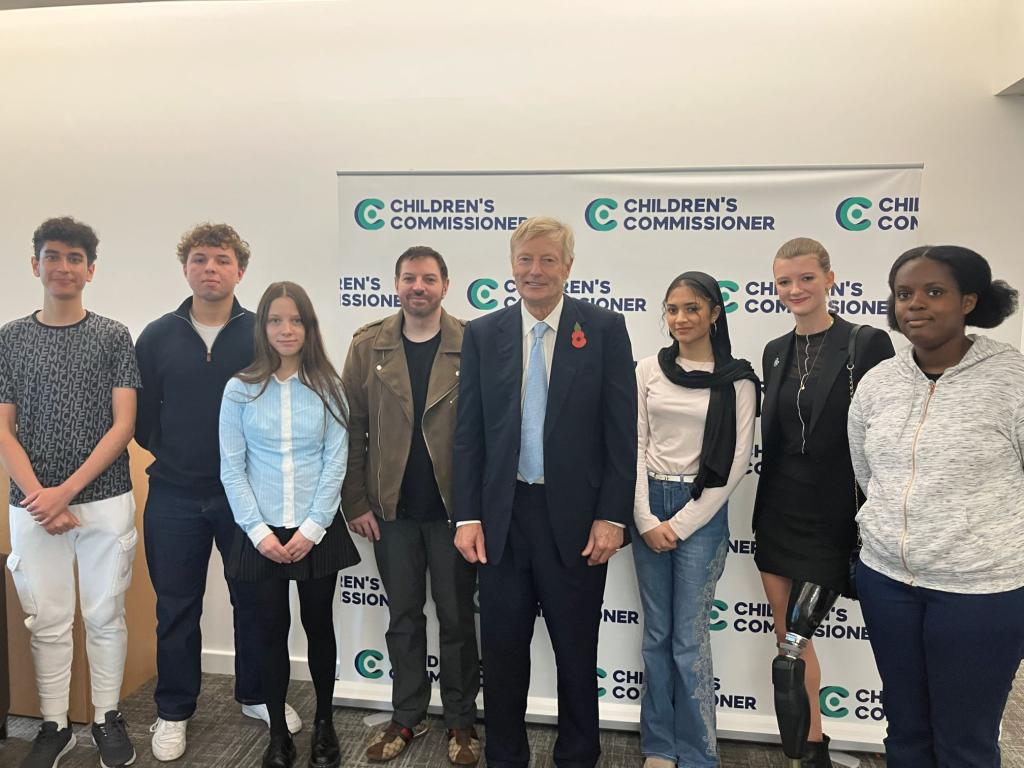
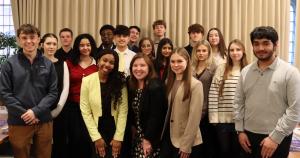
Left to right: Yusuf, Anthony, Violet, Fabio D’Andrea, Lord Nash, Ariana, Annabel, and Valerie.
Views from the Youth Ambassadors:
What do you think about a ban? What are the major problems that need addressing online?
Yusuf: “I wouldn’t say a total ban, but there needs to be tougher restrictions and more accountability with the onus really on the social media companies – fines where they are falling short in keeping those standards and letting inappropriate content get to the screens of young children.”
Violet: “I think the government should ban social media for all of those under 16 as parents can’t teach children everything. They can restrict their screen time, but they can’t teach them to not see their body image in a different way. [These aren’t things] you can teach. They can’t teach you to not get addicted to something, or not to have your attention span lessened by social media, which are the main harmful things that come from social media.”
Ariana: “When I had PSHE lessons in school I thought to myself, how many people are actually taking this seriously? And I think we need to think about the teaching methods and how we teach younger people about online safety and social media. I’m a bit in the middle about social media being banned altogether for under 16 but there are definitely features [we need to restrict].”
What’s your biggest concern about social media?
Anthony: “That it’s used to spread fake news and misinformation, especially about global events, which can easily deceive children.”
Valerie: “The rise of discriminatory language and comments that can be found on social media, especially relating to controversial topics like immigration and global conflict.”
Annabel: “From my side, it’s more positive. I’ve had social media that showcases my work and my advocacy since 14 – but all of my accounts have always been parent-supervised. I was diagnosed with bone cancer when I was 13 years old and I lost my left leg so my social media accounts have charted how I’ve survived and tried to thrive.”
Advice to younger self?
Yusuf: “Be careful with social media, but also don’t be burdened so much by what people say about its negative side – actually try to harness what is available to you and your platform for a good purpose. Social media can be a source for good.”
Anthony: “I’d definitely try to put myself in the shoes of social media companies and understand that their intentions aren’t always going to benefit me – [so] I need to use social media and manipulate in a way that’s going to benefit myself.”
How would you redesign the online world, internet, social media, to be a better and safer place for children and young people?
Valerie: “I would consult with children and ask them what the main issues they encounter on social media are. I think growing up in school I’ve been taught about e-safety and about things like nudes and make sure that you don’t send them and what to do if you do send any – but I’ve not been taught about misinformation or the fake news you see on the internet.”
Ariana: “If you look at the gaming world, you can have chats which I think should be restricted for children under 16 because you are talking to complete strangers. And I think there should be a certain age where you are allowed to comment on Instagram, for example, because that kind of [thing] influences your algorithm. And you should be mature enough to handle that.
Violet: “The problem isn’t just social media, but the use of a phone. If children didn’t have social media, they’d use a phone for something else. For example, before I had social media, I could spend hours playing pointless games on my phone. I guess the effects of social media are a lot worse on attention span and I can tell my attention span has lessened since switching from games to social media.”