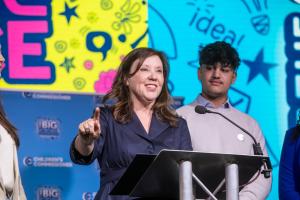
On Friday 8th May, the Children’s Commissioner, Dame Rachel de Souza hosted her second Festival of Childhood in collaboration with Science and Industry Museum, Manchester. Below is the transcript of the Commissioner’s opening keynote accompanied by three of her Youth Ambassadors.
Good morning everyone.
I am Dame Rachel de Souza and I’m the Children’s Commissioner.
I want to give you all a warm welcome to this wonderful event, my second Festival of Childhood!
Perhaps unsurprisingly, this event has resulted in much discussion with my office about the future of childhood.
Of some of the trends that we are seeing and hearing about from children.
I’ve heard that it is harder for children to be children these days.
That we have changed what it means to experience childhood.
That as we slough off the harder edges, smooth them out, we make a childhood that is more comfortable, and yet far less rewarding.
I have heard this.
But I do not think that safety and development are always in contrast.
And if, or when they are, let us have the conversation.
After all, ‘the most beautiful thing in the world,’ as Robert Frost wrote in his Notebooks, ‘is conflicting interests when both are good.’
I certainly believe that it is important that childhood contains moments where children can walk away with bruised skin or scraped knees; with the indelible mark of human worldly experience.
And as I have discussed this, and will hear from my Youth Ambassadors today,
I noticed something.
We hear about a sense of lack.
It’s the same for my office.
Many discussions around contemporary childhood begin or end with a sense that it is different.
It’s often quite hard to put your finger on it.
To prove exactly what is going wrong, or why.
But when you read reports where a child reports over 6 hours of screen time, and says that it feels like a waste of their precious time…
Well, you do not need to stake out a strong virtue ethics position to arrive at the feeling that something is just wrong.
And so ahead of my next mass survey, I commissioned a poll of the nation’s children.
The results have brought what we need to do into ever sharper focus.
We are about to legislate to hand children the vote.
And yet 28% of them don’t know how they’d vote, and a further 20% don’t know if they will.
This isn’t a children-specific issue – general election turnout has been decreasing for adults – but unlike adults, the overwhelming majority of children have 6 hours a day where the state tells them things.
We must use this time, and do everything we can to empower them as they become voters.
But if there is one thing to take away, it is this.
Children know something is wrong.
Only 7% of them told me they had no worries for their future.
Seven percent.
Their main worries reflect those of the adult world – they are worried about getting jobs and having enough money.
But in third place, ahead of AI, climate change, and global conflict, is having friends.
It was that statistic that did it for me.
We need other people.
Children need people.
Always have, always will.
I began my career as an RE teacher, and perhaps it was due to that I found myself considering a line from Simone Weil’s The Need for Roots.
She said that “Man requires, not rice or potatoes, but food;
Not wood or coal, but heating.
In the same way, for the needs of the soul, we must recognize the different, but equivalent, sorts of satisfaction which cater for the same requirements.”
She was right.
Children need the underlying function, not the specific form.
And as I look into the future, I fear that we will confuse this for children.
Let me tell you what I mean.
Children do not need lessons, nor educational materials.
They need teaching.
Children do not need ‘diversions’ or ‘activities’.
They need relationships.
Children in care do not need ‘interventions’ and ‘placements’ .
They need love.
We could very well plonk a child in front of a screen rather than send them to school.
If I can be very honest with you, I rather suspect that there’s a few tech boosters who’d have us do just that!
But we could do it.
After all, they’d have had lessons.
They’d have been given educational materials, wouldn’t they?
And yet we would not recognise them as having been taught.
We’d recognise it – rightly – as missing something fundamental.
Missing the ‘real thing.’
Weil might say that it had lost its roots.
I would say it was missing its very soul.
It would be a simulacrum, a hollow representation of the real thing, lacking an essential essence.
As Eliot observes in The Hollow Men: “Shape without form, shade without colour. Paralysed force, gesture without motion.”
Today, I announced polling that shows children are not yet equipped to vote.
I cannot help but feel that it is deeper than that.
Democracy is not a thing that happens every five years, at elections.
It is not a thing that lives in a polling centre or a booth.
It does not spring into being as we show up to vote in a general election.
It is a living thing or it is nothing at all.
Children do not just need a mock election in school.
They need to be formed, educated as citizens of this nation.
The messy and beautiful work of democracy happens every day, all around us, and we so often simply forget children as part of it.
We offer them no political education, and are surprised they feel ill-equipped for active citizenship.
How often, I wonder, do we do this elsewhere?
‘Oh yes, I have listened to children. The school council gathers once a term… and then we ignore them.’
‘Oh yes, I have taken into account the needs and views of children. I asked my best policy person, who’s 37, about their needs.’
‘Oh yes, children are connected, they have community. No, very rarely in person, but they’ve watched 4 hours of another person live-streaming today.’
I worry we have a system that means children’s first experience of democracy is being ignored at school council.
I worry we ask questions of children, and then do what we want.
I worry that social media offers an experience, a mode of being, where children – goodness, let’s face it, where all of us – feel never truly alone and never truly alive.
The purpose of my role, of the Children’s Commissioner, is to rectify that.
To protect and promote the rights of children, to ensure that they are listened to.
To ensure they are respected.
This is why I am setting out once again to speak to children and survey them.
My goal is, I am unafraid to tell you, ambitious.
I aim to hear from one million children.
And I aim for this consultation to be the real thing.
When I listen to children, I truly listen.
I will take what they say and I will act.
So, this is my goal over the next year.
Truly listen.
To act with and for children. Because we know what they need.
Fasanya, Youth Ambassador: We need adults to listen to us – really listen.
Temi, Youth Ambassador: We need those in power to take on what we say, and act on our behalf.
Ella, Youth Ambassador: We need a political system that will focus on ensuring that what children get is never watered down, but what we need and deserve.
Fasanya, Youth Ambassador: Every child is entitled to a rich and joyous education that never loses sight of the human person at the core.
Temi, Youth Ambassador: Every child is entitled to a world that responds to their needs, so they feel part of a community and a nation that respects them.
Ella, Youth Ambassador: Every child is entitled to a life that includes love, for it is the end point of the human experience to love.
This is why I am launching my survey. It is why I will be speaking to children where they are, from Hadrian’s Wall to Land’s End.
Because children need human connection, and lives that allow space for meaning.
For whatever incandescent and aethereal stuff it is that souls are made of.
I stand ready to devote my final year in office to bringing this about.
Thank you all.