

As a parent or carer one of the most important parts of your role is keeping your child safe. Parenting doesn’t come with instructions – it can be overwhelming, especially when childhood has changed so fundamentally from what we recognise. It can be hard to keep up with the changes in their lives.
But being a parent or carer is also a privilege, one that cannot be treated lightly, or outsourced. That’s why my message is simple: you are not supposed to be your child’s friend. Often, you will have to make difficult decisions when the only clear guidance available is often your own gut instinct.
Today, parents are confronted with a seemingly impossible situation: do you let your child go online, and risk them being exposed to a series of harms? Or do you prevent them from accessing a part of the world that is so important to the way children socialise, learn and play – and which is now almost an inevitable part of life?
With so much information about what you should and shouldn’t be doing, the often complicated and time-consuming parental controls on individual social media platforms that get updated every couple of months, and the ongoing debate about their role in the fight against dangers online, parents and carers can understandably feel powerless and fearful about their children’s online lives.
The last time I published a guide like this, it was to help parents and carers navigate difficult conversations about sexual harassment online. This guide is different in scope, in recognition of the complex, rapidly evolving landscape in which children – and we, as parents – are navigating. It focuses on the challenge of managing children’s everyday online habits.
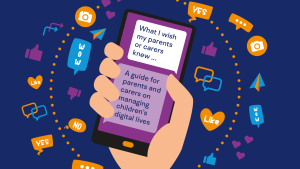
This guide is designed to demystify some of these issues, to help make talking to your child about them easier. It offers advice on setting boundaries and bringing up difficult topics that cannot be ignored – not just once, in a cursory way, but regularly. I hope it will help you navigate an online world that is not built for children, nor designed with their safety at heart, while I and many others work hard to compel technology companies to make their platforms safe for all ages.
Since my last guide, the Online Safety Act has come into force across the UK, which means that the content children see should now be regulated. It is a landmark piece of legislation, though it is far from perfect and there is still so much further to go to make its ambitions of making the UK the safest place for a child to be online a reality. I will be monitoring the impact of the Online Safety Act on children’s safety very closely. I am clear that if, after the Act is fully in force, children are still seeing – or stumbling upon – harmful content, then we need to look seriously at the strongest possible interventions, including removing children under 16 from social media altogether. In particular, I will be looking closely at the results of Australia’s social media ban, which came into force just last week – it’s absolutely right that we take evidence from around the world to tackle this global risk to children.
I also know your concerns about your children’s phone use go far beyond the content itself. Children and parents and carers alike tell me it is not just harmful content that concerns them, but habits. How much scrolling is too much scrolling? How can I set a rule around phone use? Does my child know they can talk to me if something bad happens to them online? These are all things that are covered in this guide.
This guide was written with the direct involvement of children in England. It is a reflection of their views. My office visited schools to speak to teenagers, and spoke to my Youth Ambassadors and Youth Special Educational Needs and Disabilities (SEND) Panel to get their expertise on what works and what doesn’t work between parents or carers and children in the 21st Century.
Habits have formed gradually around the parts of the online world we are all familiar with – we are all aware of our own scrolling habits and the challenge of putting down the phone to be present. We are now seeing these familiar habits translate to new ones in younger generations – and it is frightening. Artificial Intelligence (AI) is everywhere – it is in classrooms, doctors’ surgeries and is replacing traditional search tools. The gap between parents’ and children’s use and understanding looks to be the next frontier in parenting in the digital age.
Being a parent or carer is not a job we can entrust to anyone else – no politician, no professional, no tech boss. My recent survey of school leaders in England found that the majority listed online safety as one of their biggest concerns for their students – despite the fact that most (90% of secondaries and 99.8% of primaries) already restrict mobile phones during school hours. The solution therefore cannot be simply to ban phones – it must be communication, more of it, not just confiscation.
The message I want you to walk away with is to talk early and to talk often. Meet your child with patience, compassion for them navigating this new and rapidly developing world – the same compassion we deserve for ourselves – and with kindness. Trust your instincts – and take the steps to educate yourself.
Whenever I speak to children about what they would do differently when it comes to being online, with the benefit of hindsight, I ask them: would they give a smartphone to their own teenager? Almost unanimously, they tell me no. They want to be protected from it for as long as possible.
As parents or carers, our job must begin and end with our children’s care and safety. It’s what they expect and what they want from you. As one young person told me: “Don’t be afraid to be firm… If you are worried [that] your child is seeing harmful content and you don’t know what they’re watching and it’s affecting their behaviour, just take it that you know best – they don’t.”